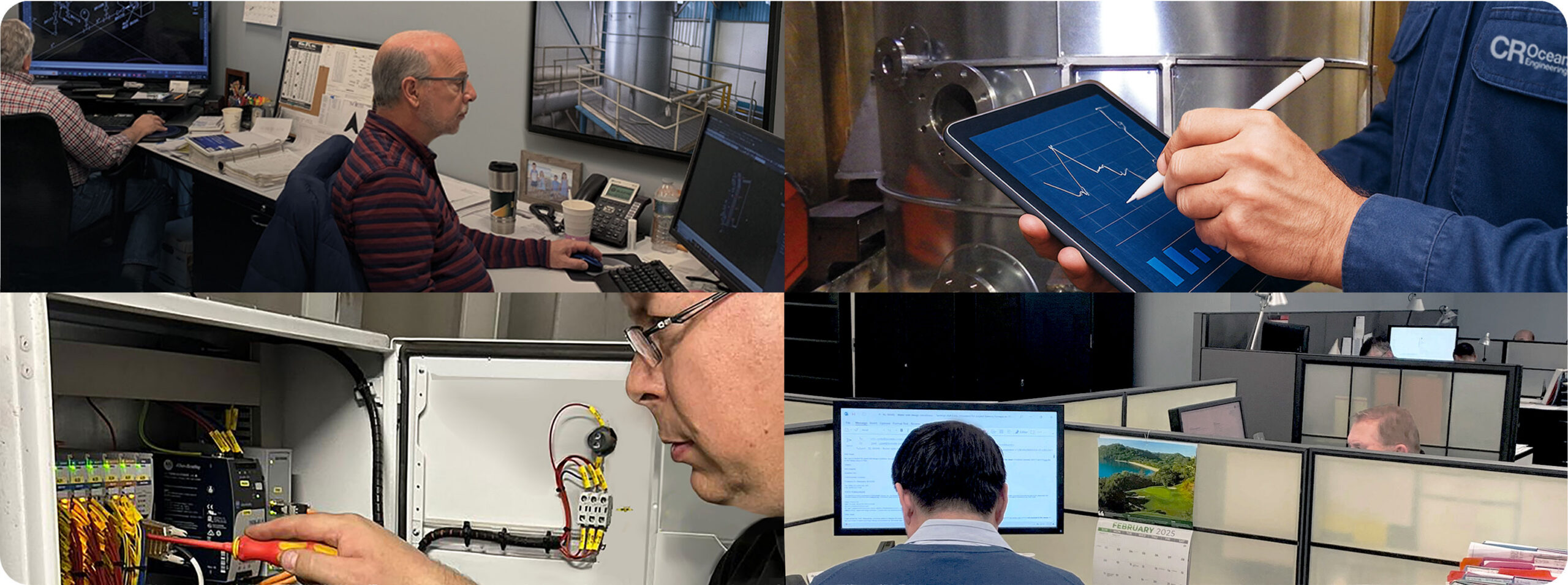
We provide end-to-end servicing for all types of marine scrubbers—whether we built them or not.
Comprehensive Marine Scrubber Service for All System Types: CROE provides full-spectrum marine scrubber service across open-loop, closed-loop, and hybrid exhaust gas cleaning systems, not just our own. Our teams support installations from all major manufacturers, delivering inspection, maintenance, repair, and retrofit expertise regardless of original system design. Whether servicing newly commissioned vessels or aging installations operating under demanding conditions, CROE ensures continued performance, reliability, and regulatory compliance.
Regular Inspections: Routine inspections are essential for early detection of potential issues and long-term scrubber reliability. And we have the people, resources and know-how to make this happen.
Visual Checks: Inspecting the scrubber tower, pumps, nozzles, valves, and all associated piping for wear, corrosion, blockages, or leaks. CROE technicians are trained to diagnose patterns of degradation common across all manufacturer designs.
Sensor & Control Checks: Confirming the proper function and calibration of pH, temperature, turbidity, flow, pressure, and gas analyzer sensors. Crew Training and Analyzer Certification are also available.
Structural Integrity: Conducting wall-thickness gauging, hotspot analysis, and corrosion mapping of piping and tower sections. These assessments are especially important for non-CROE scrubbers that may use materials prone to acidic corrosion.
Internal Cleaning: Clearing and washing packing materials, mist eliminators, spray headers, and nozzles to restore optimal airflow and gas-liquid contact.
Chemical Cleaning: Applying approved chemical agents that dissolve stubborn scaling and deposits without damaging system components.
Sludge Water Treatment: For closed-loop and hybrid scrubbers, cleaning the wash water treatment units, tanks, sensors, and sludge systems. CROE ensures sludge is safely dewatered, contained, and prepared for compliant onshore disposal at port reception facilities.
Replacement and Repairs: CROE teams stock and install spare parts for any brand of scrubber, ensuring fast turnaround worldwide.
Spare Parts: Filters, seals, dosing lines, pumps, gaskets, demisters, and more—replaced as per manufacturer guidance or CROE’s enhanced preventive-maintenance standards. Replenishment of alkaline reagents (e.g., caustic soda) in closed-loop systems.
Corrosion Repair: Repairing or replacing corroded pipes, valves, and tower sections using marine-grade metals, composites, or GRE piping. Specialized welding and fabrication teams are available at CROE-partner ports worldwide.
Software Updates: Updating PLC logic, alarm thresholds, performance parameters, and reporting systems to ensure compliance with evolving regulations.